Investing in rental properties can be a lucrative way to build wealth, but success hinges on understanding the numbers behind the investment. Return on Investment (ROI) is a key metric that helps you evaluate whether a property is worth your time and money. Here’s how to analyze rental property ROI like a pro.
Step 1: Understand the Basics of ROI
ROI is a performance measure used to evaluate the profitability of an investment. For rental properties, ROI compares the net profit you earn to the amount of money you’ve invested. It is expressed as a percentage:
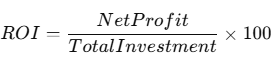
The higher the ROI, the better the investment. Let’s break down the components you’ll need to calculate ROI accurately.
Step 2: Calculate Rental Income
Start by determining the property’s monthly rental income. Research comparable properties in the area to set a competitive rate. Multiply the monthly rent by 12 to calculate the annual rental income:
Example:
If you charge $2,000 per month, your annual rental income is:
 Step 3: Account for Operating Expenses
Operating expenses include all the costs associated with managing and maintaining the property. Common expenses include:
-
Property taxes
-
Insurance
-
Maintenance and repairs
-
Property management fees
-
Utilities (if paid by you)
-
HOA fees (if applicable)
Add these up to find your annual operating expenses.
Example:
If your annual expenses are as follows:
-
Property taxes: $3,000
-
Insurance: $1,200
-
Maintenance: $1,500
-
Property management: $2,400
Your total annual operating expenses are:
Step 4: Calculate Net Operating Income (NOI)
Subtract the annual operating expenses from the annual rental income to find the Net Operating Income (NOI):

Example:
$24,000 - $8,100 = $15,900
Your NOI is $15,900.
Step 5: Determine Your Total Investment
The total investment includes:
-
Purchase Price: The cost of buying the property.
-
Closing Costs: Fees for inspections, legal services, and lender charges.
-
Renovations/Repairs: Any upfront costs to make the property rent-ready.
-
Down Payment: Your initial cash outlay if you’re financing the property.
Example:
If you paid $250,000 for the property, $10,000 in closing costs, and $15,000 in renovations, your total investment is:
$250,000 + $10,000 = $15,000 = $275,000
Step 6: Calculate ROI
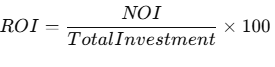
Now, divide the NOI by the total investment and multiply by 100 to find the ROI:
Example:
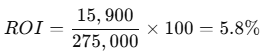
Your ROI for this property is 5.8%.
Step 7: Adjust for Financing (Optional)
If you’re using a mortgage, your ROI calculation changes. Subtract annual mortgage payments from the NOI before calculating ROI. Include your down payment as part of the total investment.
Example with Financing:
-
Annual mortgage payments: $12,000
-
NOI after mortgage: $15,900 - $12,000 = $3,900
-
Down payment: $50,000
-
Total investment: $50,000 (down payment) + $10,000 (closing costs) + $15,000 (renovations) = $75,000
Step 8: Compare to Benchmarks
A good ROI depends on your goals, market conditions, and risk tolerance. As a general rule:
-
8-12% ROI: Strong for most rental properties.
-
5-7% ROI: Acceptable for lower-risk investments.
-
Below 5% ROI: May not be worth the effort unless appreciation potential is high.
Step 9: Factor in Potential Appreciation
ROI doesn’t account for property value appreciation, which can significantly boost your returns over time. Research market trends to estimate potential gains.
Analyzing rental property ROI like a pro involves thorough research and attention to detail. By understanding the numbers and following these steps, you can make informed decisions and maximize your investment’s profitability. Whether you’re a beginner or an experienced investor, mastering ROI calculations is key to long-term success in real estate investing.