Ft Lauderdale Area Home Search
Ft Lauderdale Real Estate Review
Welcome to my blog. I have been writing articles for home buyers and home sellers in the Greater Fort Lauderdale area since about 2007. If you are thinking of buying or selling real estate you can find some helpful tips right here. If you would like to get them sent directly to your inbox just sign up below.
Subscribe to My Weekly Newsletter
Florida's hottest real estate spot is... Fort Lauderdale?
FSBO - For Sale By Owner Statistics
- FSBOs accounted for 8% of home sales in 2014. The typical FSBO home sold for $210,000 compared to $249,000 for agent-assisted home sales.
- FSBO methods used to market home:
- Yard sign: 42%
 Friends, relatives, or neighbors: 32%
- Online classified advertisements: 14%
- Open house: 14%
- For-sale-by-owner websites: 15%
- Social networking websites (e.g. Facebook, Twitter, etc.): 15%
- Multiple Listing Service (MLS) website: 10%
- Print newspaper advertisement: 3%
- Direct mail (flyers, postcards, etc.): 3%
- Video: 2%
- Other: 1%
- None: Did not actively market home: 25%
- Most difficult tasks for FSBO sellers:
- Understanding and performing paperwork: 12%
- Getting the right price: 6%
- Preparing/fixing up home for sale: 6%
- Selling within the planned length of time: 18%
- Having enough time to devote to all aspects of the sale: 6%
Source:2015 National Association of Realtors Profile of Home Buyer and Sellers
Related:
A FSBOs Guide to Selling Your Home on Your Own
The 5 Most Common Florida Real Estate Forms and Contracts

Serving The Greater Fort Lauderdale area since 2006
You can reach me 954-895-2431


If You Like This Post, Please Share. Thanks!
Where Does Your Commission Go?
The market commission these days is 6%. On a sale of a $350,000 property the commission is about $20,000 (rounded down a bit for simplicity).
I admit this is a significant chunk of change. So, is your agent putting ALL of that in his or her pocket, taking a luxury vacation, or buying new car or boat with it? No. Not even close.
There is about a 75% chance they will have to split it another agent who is working with the buyer. So there goes half of it.
The agent then splits the rest of it with their broker. Split plans varies among brokerages, The broker gets anywhere from 0 to 50% of the gross commission. The difference usually depends on the amount of support the agent gets from the brokerage, such as advertising, training, leads, legal support and so on. A typical split is about 20% from the agent to the broker of the first $100,000 of gross commission. The broker has expenses too, like rent, auto and gas, wages for support staff, Advertising and so on.
Agents are independent contractors. Many, like myself, are even incorporated. They operate like small businesses and there is significant overhead. After the split with our broker we pay for things out of pocket things like gas, insurance, board dues, licensing fees, telephone, education, advertising (both property ads and self promotion).
In the above example $20,000 is a significant amount of money. But we are tasked with bringing the seller a ready willing and able buyer with the $350,000 it takes to buy the property. Then getting them and the seller though the increasingly complicated closing process.
Commissions are negotiable usually. Keep in mind that a the difference between a 6% and a 5% commission is just 1% to the seller but it is a 17% percent reduction to the agent (1/6 equals 0.169). If the homes in your neighborhood are mostly offering 3% to the buyers agent and yours is only offering 2.5% you will get less traffic to your listing.
Developers offer as much as 6% to a buyers agent on their new construction projects because they understand how much the commission affects traffic. This is what you are competing against. Try to think of the commission not so much as an expense, but an incentive for agents to bring you buyers. More traffic to your listing means more offers, and more offers means more money in your pocket.
Related:
What Does It Cost To Sell A Home In Florida?
3 Steps To Get Top Dollar For Your Home
Serving The Greater Fort Lauderdale area since 2006
You can reach me 954-895-2431
If You Like This Post, Please Share. Thanks!
Now Could Be a Good Time for Canadians to Sell Their US Property
Jan 15, 2016
Now could be a good time for Canadians to consider selling their property in the US. The conditions are becoming very favorable mostly because of the currency exchange. As of today 1 US dollar is worth 1.45 Canadian dollars. Just four years ago the USD and the CAD were trading evenly, or at par, with each other. See the chart here. That is a 45% increase since 2011. It's been 12 years since the US dollar was this strong against the Canadian Dollar.
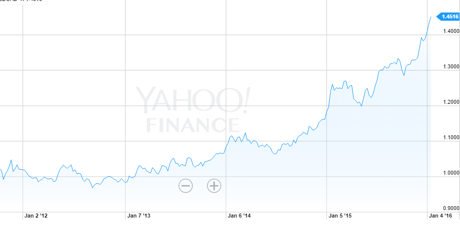
For example, if you own a property here in Florida that is worth $300,000 USD, that is equivalent to $435,000 CAD. In the past 20 years the most the CAD dollar has been against the USD was $1.60 in January 2002. We are fast approaching that point now and who knows if it will get that high. The two currencies will continue to fluctuate and there is no telling where it will go from here. Eventually it will shift again and any gains could be lost.
As it becomes more expensive for Canadians to travel and spend time in Florida and the rest of the US, I see more of them selling and taking their money home. Here in Broward County, an area very popular with Canadian snowbirds, I have noticed it has gotten tougher to sell beach and golf course properties over the past year. I see prices in those areas flattening because Canadians are not buying like they were when the two dollars were at par with each other. Some folks will argue presidential politics strengthens the argument to sell now. I think it is a bit too soon to tell how that will affect Canadian property owners.
If you are Canadian and bought a $200,000 property in 2010 or 2011 you have benefited not only with an asset that has appreciated 30% to $300,000, but the the currency exchange has given you the added benefit of an asset that is now worth double what you paid for it if you sell it and take your money back to Canada ($435,000 CAD). You can always continue to visit Florida by renting seasonally with the huge profit you are making. We are approaching the best selling season, which is now through early summer and conditions may never be this favorable again.
You can see what your property is worth at this website I run, right here. You will get an instant estimate of it's value. Be sure to then multiply the value by 1.45 to see what it is worth in Canadian Dollars. For a more accurate market valuation I would need to see your property.
If you are considering selling contact me at 954-895-2431 and I can handle it all for you. If you are outside of my area I can also find the right agent for you.
Other Recent Posts

Serving The Greater Fort Lauderdale area since 2006
You can reach me 954-895-2431
If You Like This Post, Please Share. Thanks!
Recommendation from Matt R.
 "Tom did a wonderful job. He was very hard working, communicated extremely well and managed the entire process for us. Since we were based in New York, Tom handled all aspects which included donating the furniture to charity. I highly recommend Tom Day."
Serving The Greater Fort Lauderdale area since 2006
You can reach me 954-895-2431
If You Like This Post, Please Share. Thanks!
John Jacob Astor - America's First Millionaire

 Did you know that America's first millionaire was a real estate investor? His name was John Jacob Astor. He emigrated to the the United States from Germany by way of England first. He arrived shortly after the Revolutionary War and entered the fur trade. The fur trade was very profitable for him but his real wealth came from investing in real estate in Manhattan.
He started buying land in 1799 from his fur trade profits and eventually became known as "Manhattan's Landlord". He rarely built on his land. He preferred to lease to others to build on. He became rich by correctly seeing the opportunity in the growth of New York City. He was not only America's First millionaire, He was America first multi-millionaire. When he died in 1848 he left over $20 million to his heirs. In today's money that is a massive $458 million fortune. Not bad for an immigrant son of a butcher.
Serving The Greater Fort Lauderdale area since 2006
You can reach me 954-895-2431
If You Like This Post, Please Share. Thanks!
Testimonial from Judy in Toronto
"A very special thanks to you for all your hard work, listening to all my calls and helping us through a very difficult situation. Thanking you so very much...you are a wonderful person and I would recommend you and your firm to anyone in Coconut Creek and to sell any Florida property."
Judy C.
A Testimonial From Sid in Pompano Beach
"Tom handled the sale of my condo from listing to close in 4 months with a professional attitude. He was always available for my calls and questions and made the experience a low pressure one, handled mostly on-line. Would definitely recommend him."
Sid S.
Pompano Beach
A testimonial from Mitzi K. In Illinois
On behalf of Mitzi, Sherriann and me, thank you for handling the transaction so well. You made it seem effortless!
Dave M for Mitzi
Illinois
Seven Short Sale Myths - The Truth About Selling an Underwater Home
 A short sale can be an excellent solution for homeowners who must sell and owe more on their homes than they are worth. Unfortunately, a number of myths about short sales have developed, and it is important to understand the reality of this process should you find it meets your current needs.
Myth #1 – The Bank Would Rather Foreclose than Bother with a Short Sale
This is one of the most common misconceptions. The reality is that banks do not want to foreclose on your property because the foreclosure process is incredibly costly. Banks, investors, and even the federal government have all publicly stated that if a person is qualified for a short sale, the deal needs to be considered. Overwhelmingly, banks receive more on their investment through a short sale than a foreclosure.
The qualifications for a short sale include:
Financial Hardship – There is a situation causing you to have trouble affording your mortgage.
Monthly Income Shortfall – "You have more month than money." A lender will want to see that you cannot afford, or soon will not be able to afford your mortgage.
Insolvency – The lender will want to see that you do not have significant liquid assets that would allow you to pay down your mortgage.
Myth #2 – You Must Be Behind on Your Mortgage to Negotiate a Short Sale
While this may have previously been the case, today lenders are looking for verifiable hardship, monthly cash flow shortfall, or pending shortfall and insolvency.
If you meet these three requirements and believe that you soon may be unable to afford your mortgage, act immediately. Any delay could limit your options. Do not wait until the countdown clock to foreclosure has started and you have even less time left.
Myth #3 – There is Not Enough Time to Negotiate a Short Sale Before My Foreclosure
This is a myth that probably hurts homeowners the most. Many do not realize that foreclosure is a process, and that there is time to make decisions that may result in better outcomes.
The foreclosing party—in most cases a lender—can stall a foreclosure up to the final day of the process. Today, many lenders will stall a foreclosure with as little as a phone call from you explaining that you are trying to sell, and almost all lenders will stall a foreclosure with a legitimate contract. For real estate professionals who understand foreclosures and short sales, there is time available until the foreclosure process is complete.
Myth #4 – Listing My Home as a Short Sale is an Embarrassment
It is understandable to have reservations about letting the world know that you owe more on your home than it is worth. However, according to recent estimates, more than one out of eight homeowners in the U.S. is in the same situation. You are to be congratulated for admitting you need help, taking action, and finding a professional who can work with you toward a solution.
With recent estimates showing 40-60% of U.S. sales will be short sales or foreclosures, you are not alone.
Myth #5 – Short Sales are Impossible and Never Get Approved
This is a complete falsehood. Are short sales more difficult to execute? Yes. Do you, as a homeowner, need to learn about a new process? Yes. Are they impossible? Absolutely not.
For example, agents with the Certified Distressed Property Expert® (CDPE) Designation receive thousands of short sale approvals on a monthly basis. These professionals have undergone extensive training in methods to help homeowners in distress and process short sales. While there are no guarantees in any transaction, more and more short sales are being approved regularly. This is far from an impossible process.
Myth #6 – Banks are Waiting on a Bailout and Not Accepting Short Sales
You may have heard this, but the reality is that banks (and the U.S. government) are trying to do anything they can, within reason, to avoid foreclosing on properties. It is preposterous to believe they would deny a short sale in hopes that some future legislation would pass and pay them for losses.
Today, more banks are aggressively pursuing short sales and working with agents who understand how to process them. Freddie Mac recently hosted a national training Webinar for real estate agents where they expressly stated the organizational goal of "eliminating distressed assets through modification or short sale."
Myth #7 – Buyers are Not Interested in Short Sale Properties
This is a myth that potential sellers hear all the time. Thankfully, this is just not true. In fact, many agents are getting calls from buyers who say they only want to look at foreclosure and short sales.
For buyers, short sales and foreclosures have become synonymous with "good deals." More specifically, international buyers are targeting these properties. Listing with an experienced agent who is educated in the short sale process will provide you with a great chance of quickly seeing a contract on your property.
In conclusion, Agents with the CDPE Designation have been trained in all aspects of the short sale process, and know how to deal with the parties involved in foreclosures. If you live in the Greater Ft. Lauderdale area and would like to see if a short sale is feasible for you contact me today.
Courtesy of Distressed Property Institute
Subscribe to my newsletter here.

Serving The Greater Fort Lauderdale area since 2006
You can reach me 954-895-2431
If You Like This Post, Please Share. Thanks!